
Posted by Sultan Khan | Theresia Alamsyah on 15th May 2026
Panelling Behind Your TV | TV Backboard Guide & Inspo
Wall panelling behind a TV (also called a TV back panel or TV backboard) does a few jobs at once. It gives the screen a defined backdrop instead of a flat painted plane, helps conceal cables and brackets, gives you somewhere to fit bias or feature lighting, and softens some of the room's reverb. This guide covers the TV wall panel types worth considering, what is involved in fitting one, and how to plan the lighting so the wall looks right with the TV on and with it off.
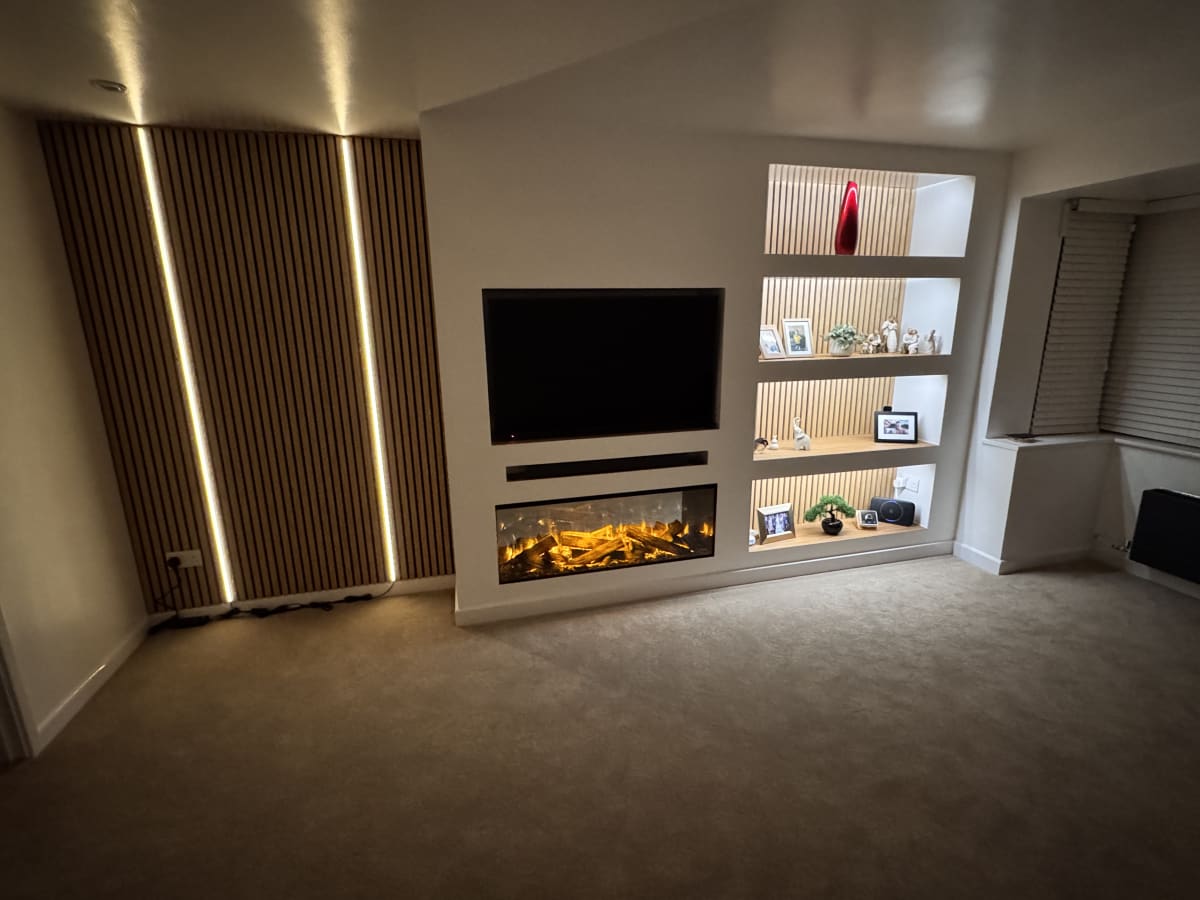
What TV wall panelling does
A TV mounted to a flat painted wall can look like a separate piece of equipment. Panelling gives the screen a proper backdrop, so the wall has a finished look even when the TV is off.
There are a few practical reasons to use wall panelling behind a TV. It gives the wall a finished surface, helps hide cables and bracket fixings, creates a cleaner route for LED strips, and can soften some of the high-frequency echo you get in rooms with hard floors, large windows and plaster walls.
The right panel depends on the room's style, the size of the TV, the wall type behind it, and the finish you want. Some options are decorative panels fitted to the wall. Others are sheet materials or mouldings that let you build the TV backdrop from scratch.
Types of TV wall panels
The options below cover most TV wall panel projects: acoustic slat, standard slat, fluted, panel moulding, MDF backing boards and PVC effect panels. Start with the finish you want, then check the wall type and fitting method.
| Panel type | Works best for | Check before fitting |
|---|---|---|
| Acoustic slat | Modern TV walls and slight softening of room echo | Bracket must fix through to the wall, not into the felt panel |
| Slat / fluted | Wood-effect lines, cleaner wipe-down surfaces and larger screens | Uneven walls show more on broad rigid panels |
| Panel moulding | Traditional rooms, painted feature walls and chimney breasts | Set the TV height before fixing rails, dado or picture moulding |
| MDF backing board | Painted TV back panels, routed cable channels and custom shapes | Allow for priming, painting and access to cables before final fixing |
| PVC panels | Marble, stone, tile, brick and plain matt finishes | Choose matt or textured finishes where screen glare is a concern |
Acoustic slat panels
Acoustic slat panels are MDF slats, often veneered, fixed to a felt backing. The slats give the wall vertical depth, the felt softens some of the mid and high-frequency reverb in the room, and the channels between slats are useful for hosting small LED strips. They suit modern living rooms and pair naturally with dark or warm wood finishes.
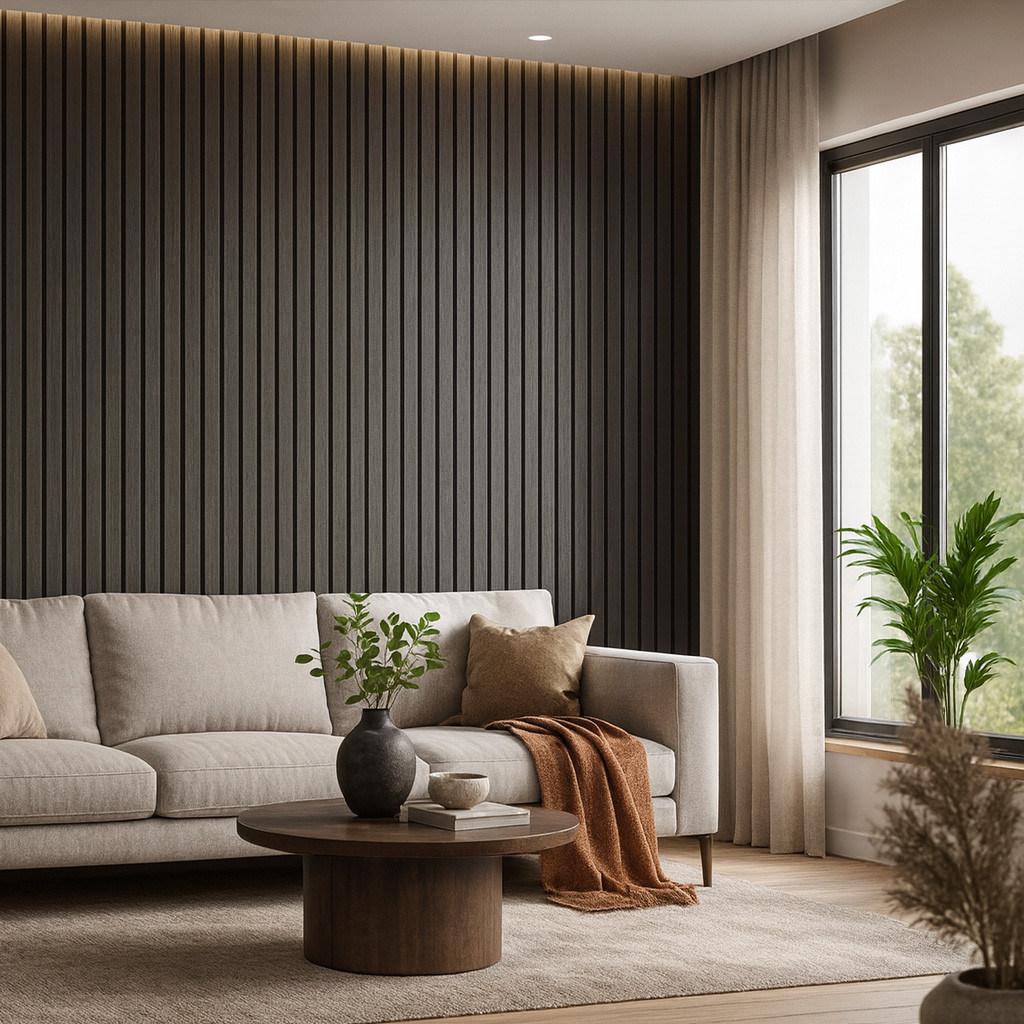
Acoustic Slat Wall Panel - Charcoal Black
Charcoal felt backing with painted slats. Sits well behind a TV with a dark bezel and a soundbar below. Also available in lighter wood finishes if the rest of the room is warmer.
Slat panels (low maintenance)
Slat panels give the same vertical line pattern without the felt backing used on acoustic slat. The surface is easier to wipe clean, the shadow lines are sharper, and the wood-effect finishes work well across a full TV wall. Natural oak gives a warmer finish; charcoal suits darker rooms where you want the screen and wall to sit together.
Waterproof Pure Natural Oak 3D Slat Wall Panel
Large-format slats in a natural oak finish. Suits full-wall installations in living rooms or feature planes around a wall-mounted screen. The waterproof finish is not just for bathrooms; it protects the panel from cleaning solutions.
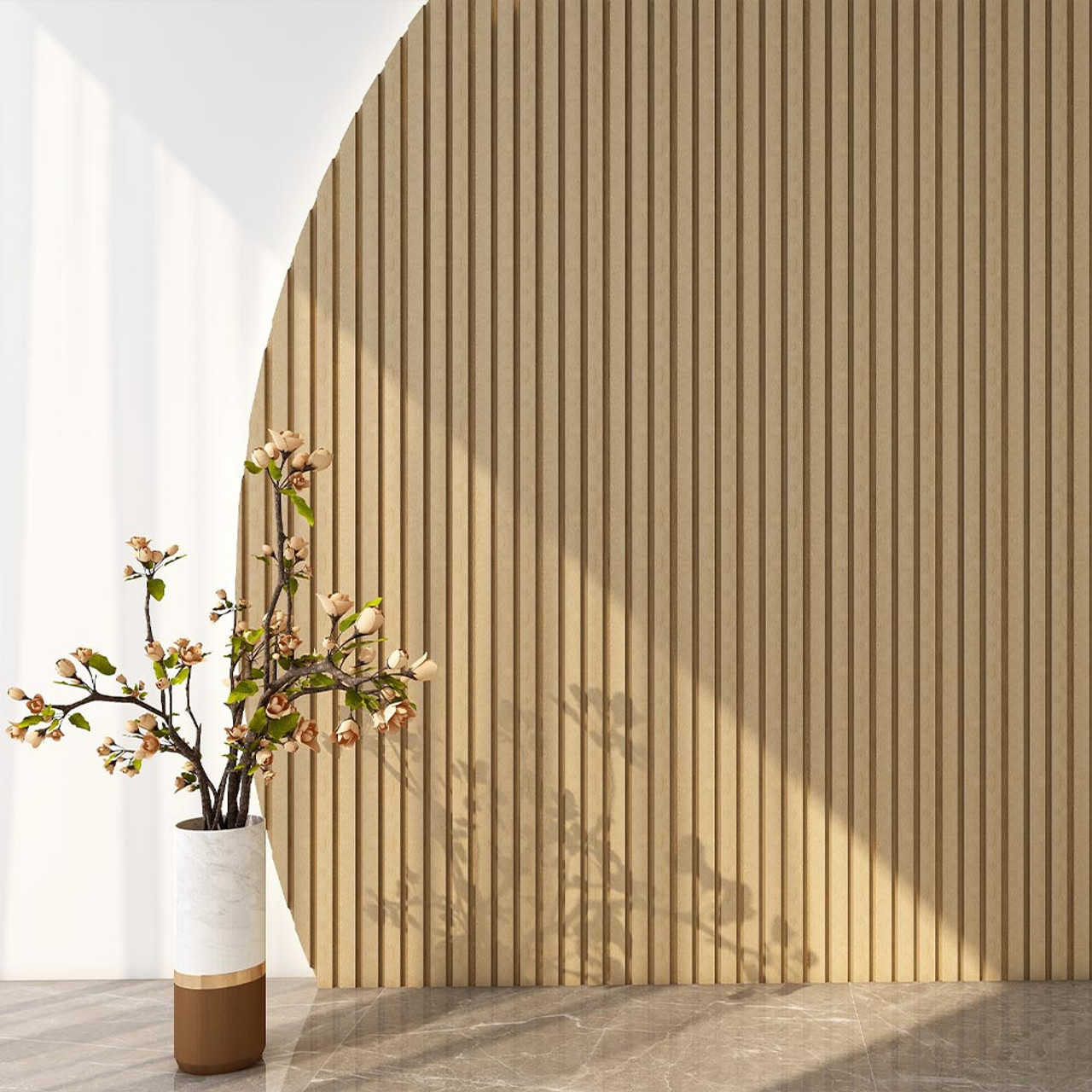

Fluted panels
Fluted panels are ridged panels with continuous vertical lines running top to bottom. They are not as common behind TVs as slat panels, but the quieter line pattern can help with very large screens because the wall does not compete with the picture. It is still a rare aesthetic in British homes.
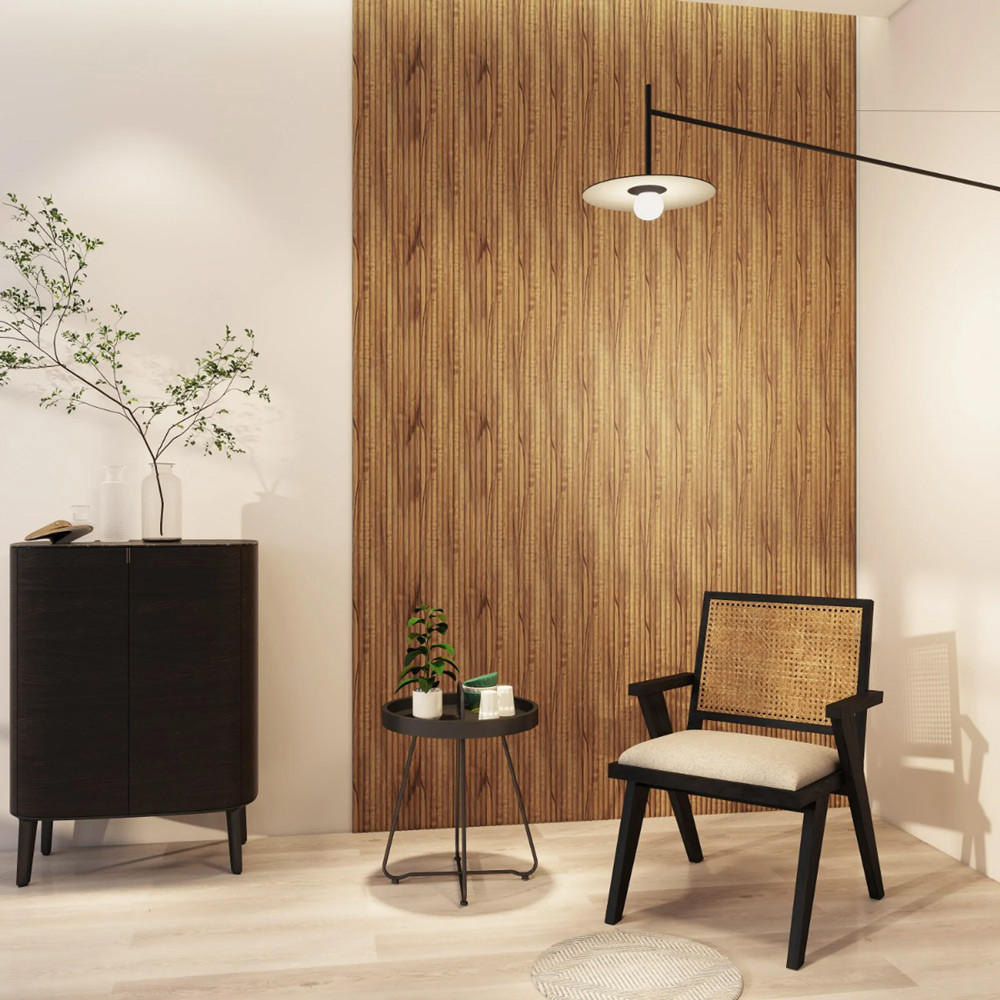
Waterproof Natural Oak 3D Fluted Wall Panel
Continuous vertical reeded lines in a warm oak finish. A common pick for 75 and 85-inch screens, because the line pattern stays cleaner at distance than slat. They are also paintable.
Panel moulding and panelling kits
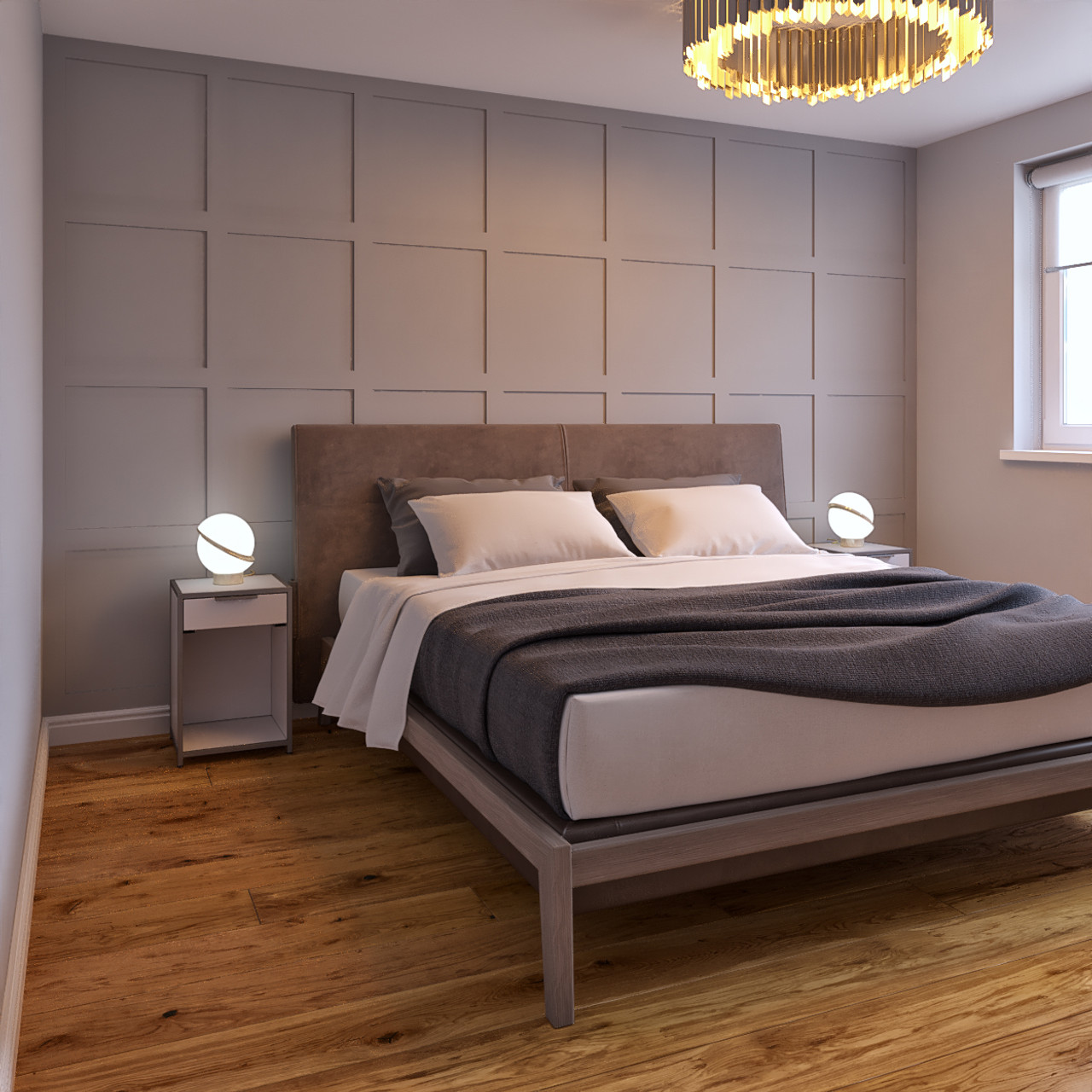
If the room is period or transitional, or the wall needs to look like joinery rather than cladding, panel moulding is usually the better route. Kits make the layout easier because the strips and mouldings are planned together, but you can also use individual wall panel mouldings or panelling strips for a custom TV wall. Use our shaker panel calculator to plan the layout before you order.


MDF backing boards
A plain MDF backing board is useful when you want a painted TV back panel rather than a visible slat, fluted or moulded product. It can be cut to the width of the TV wall, routed for cable channels or LED runs, and painted to match the room. MDF is also easy to work if you want shallow grooves, curves, inset shapes or a simple flat backdrop behind the screen. It is also a practical way to achieve a floating panel look with MDF sheets.
MDF boards from Skirting World
Use these as a paintable TV back panel or backing board when you want full control over shape, routing and finish.
View MDF boardsPVC and plastic wall panels
PVC wall panels suit TV walls when you want a wipe-clean marble, stone, tile, brick or plain matt finish without the weight and cost of the real material. Matt finishes are usually easier around screens because they diffuse light more softly than gloss panels.


Lighting for TV wall panels
A TV wall needs two lighting settings: one for watching TV and one for when the screen is off. The same fittings can usually do both jobs if they are planned before the panels go on.

Interior & Lighting Designer, Certified Lighting Consultant (DIALux Evo)
"A successful media wall should be designed to perform in two very different moments. When the television is on, the lighting should support visual comfort. Simply having a gentle backlight behind the screen can already soften the contrast between the bright image and the surrounding wall. Another strategy would be to have a carefully controlled ambient lighting, as this prevents the room from falling into complete darkness, and having targeted downlighting only where it serves the composition. The panelling, on the other hand, acts almost like an intentional visual buffer; grounding the screen within the wider context of the room rather than allowing it to feel like a lit rectangle pasted onto the wall."
"When the television is off, the priority shifts. This is where the lighting can reveal the wall as an interior feature in its own right. A controlled mix of subtle linear lighting, soft wall washing, and ambient illumination can bring out the inherent quality of the panels and complement the spatial rhythm. Thus, the media wall can effectively retain its own presence without becoming overworked. A well-designed scheme should not rely on the screen itself to make the wall feel complete."
Bias light, the strip of light fitted immediately behind a wall-mounted TV, is normally specified at around 6500K (D65), which matches the white point a TV picture is graded to. SMPTE's reference viewing standard and Netflix's colour-critical viewing guidance both say the same. Warmer 2700-3000K light is for mood and works well on the rest of the wall when the screen is off, but it stops being a bias light once it becomes the dominant surround.
Bias lighting: a dim light behind the TV that reduces contrast between the bright screen and the surrounding wall. It is usually set around 6500K for TV viewing.
Gloss and high-sheen finishes reflect side lighting and ceiling light back onto the screen. Matt and textured panels diffuse light and are easier to live with around a TV. If the panel is gloss, the angle of the room lights matters more than the wattage.
Common mistakes are bias lighting set too bright, single-colour RGB used as a bias light and dimmer or driver mismatches that make the LEDs flicker on camera or at the edge of vision.
How TV panelling affects room sound
Felt-backed slat panels improve room feel, but they will not turn your living room into a cinema. They reduce some of the hardness in mid and high-frequency reflections, which makes dialogue and effects a bit easier on the ear in rooms heavy on plaster, glass and hard floors. They do very little below around 200 Hz, so bass is largely unaffected.
Placement matters as much as area. The reflections that affect a seated listener most are usually first reflections off the side walls and ceiling, not the wall directly behind a flush-mounted screen. So a slat panel behind the TV is mostly a visual decision; the room sound benefits more from treating sidewalls and ceiling if the goal is cleaner audio. That is useful, because your TV panel can focus on aesthetics. Our soundproofing guide covers the wider topic.
Rigid slat and fluted panels without felt do something different again. They scatter high-frequency reflections rather than absorbing them. That can make a busy room sound less harsh, but it is not the same as adding absorption.
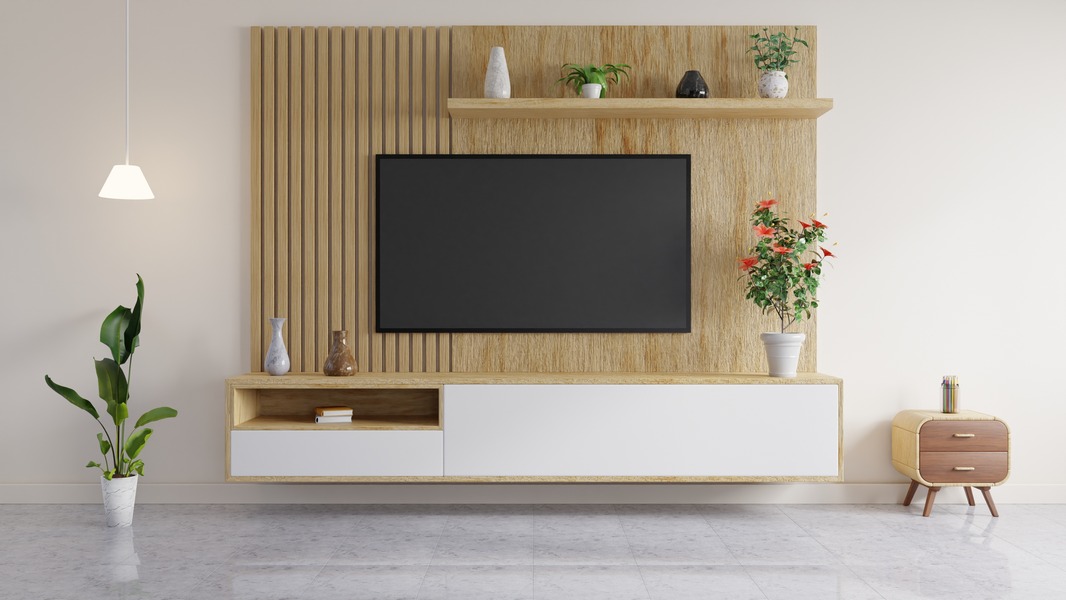
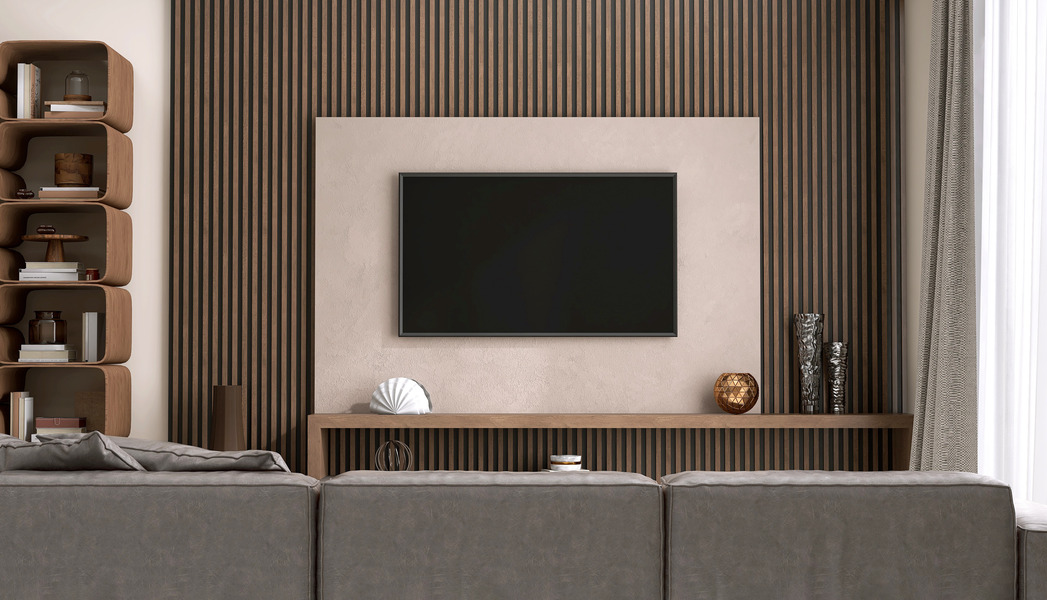
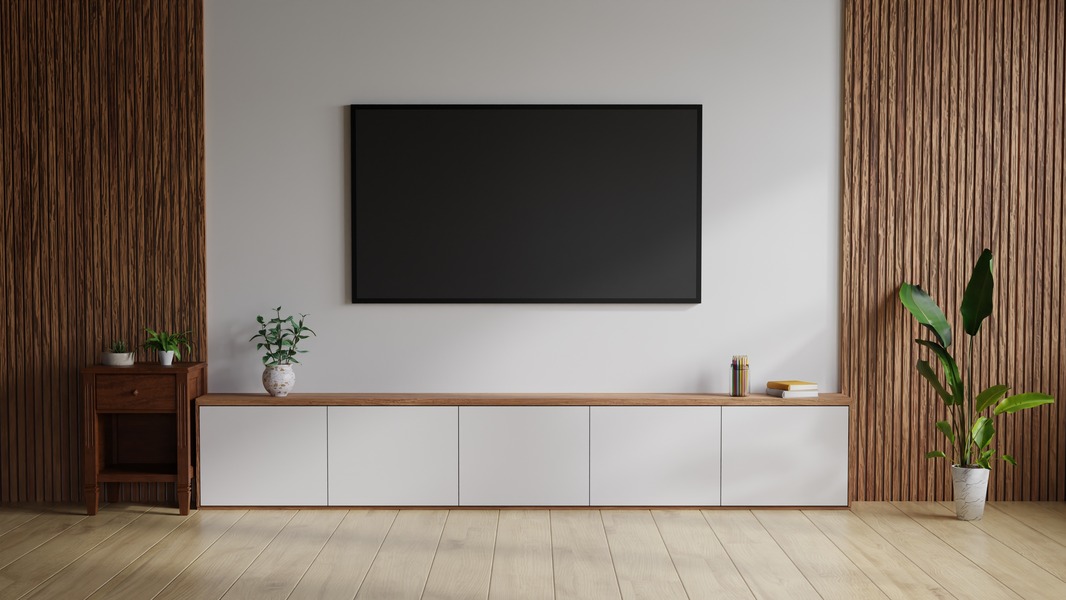
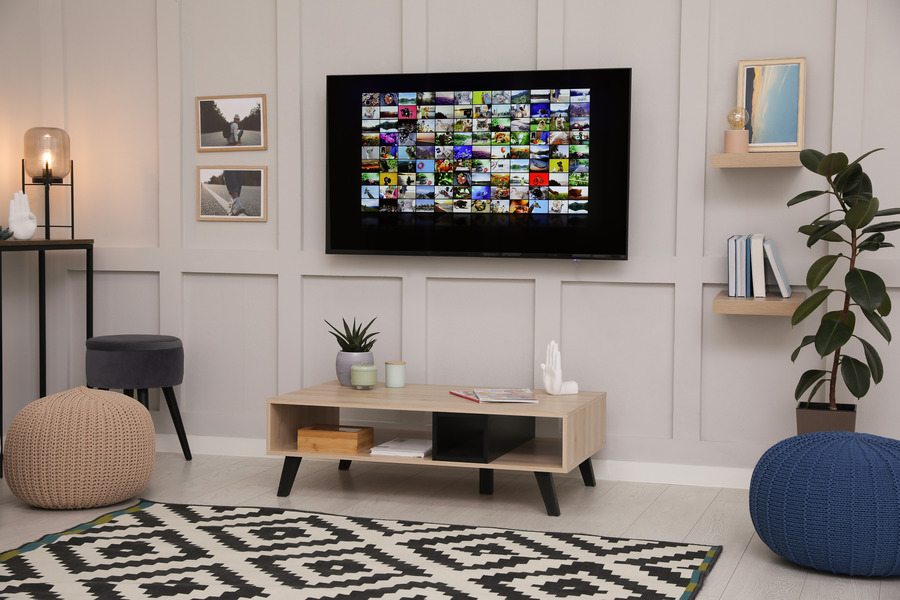
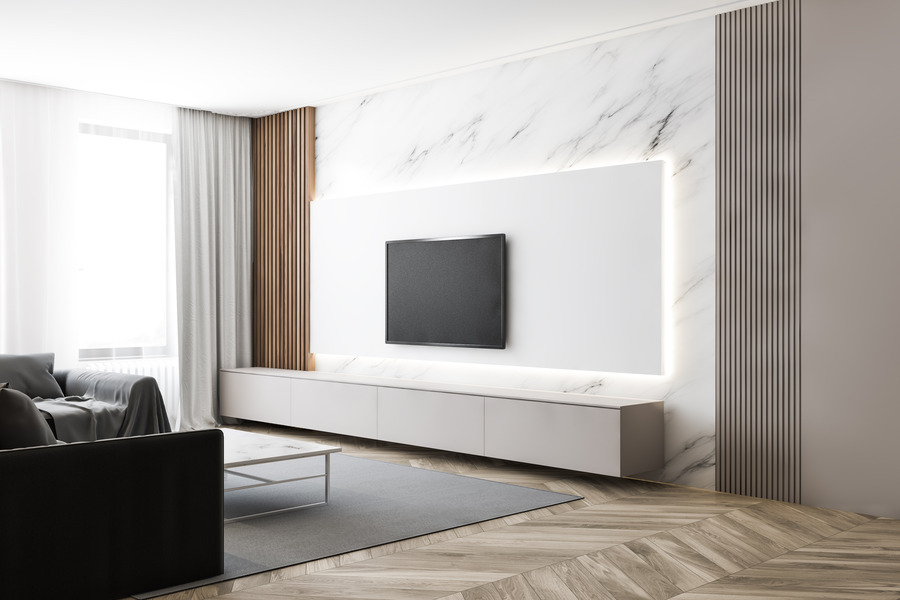
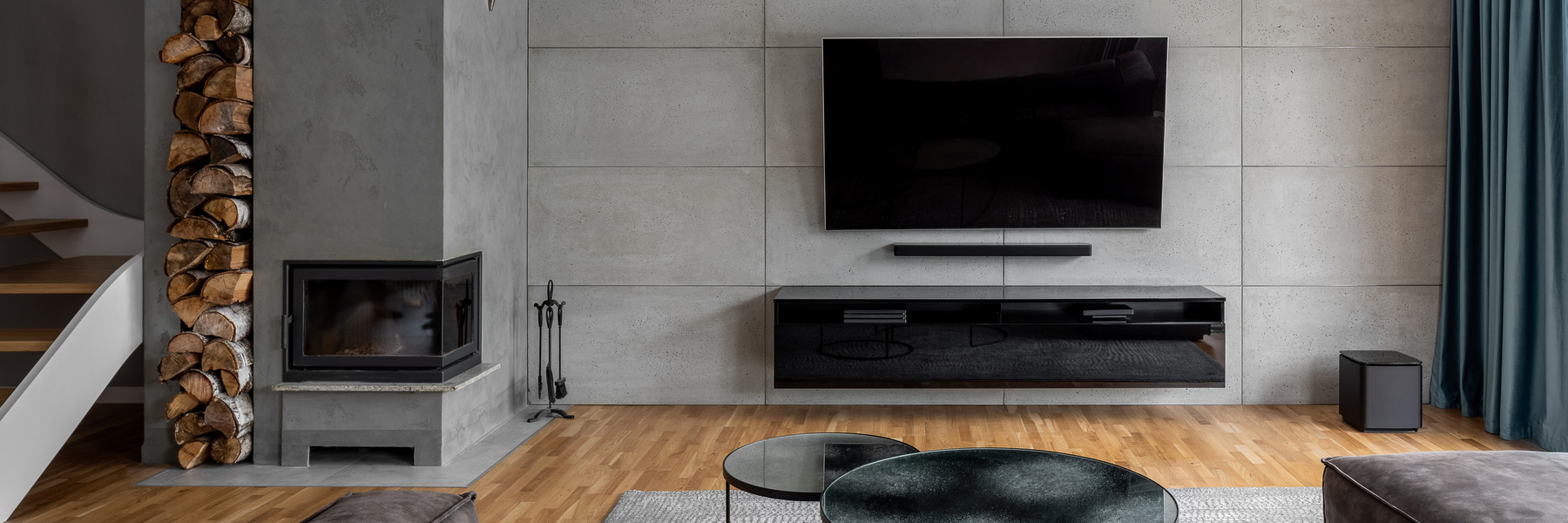
TV wall panelling ideas
Fitting panelling behind a TV
1. Where the TV bracket fixes
Decorative panelling is a finish layer, not a structural substrate. The TV bracket should fix through the panel and into the wall behind it (masonry, blockwork, a stud, or a proper plasterboard anchor). SANUS, a TV bracket manufacturer, publishes a five-times safety factor, meaning the wall should comfortably carry five times the combined weight of the TV and the bracket. With a heavy 65 or 75-inch screen on a full-motion arm, the wall and the fixings carry an overturning moment as well as the static weight, so the margin matters.
Slat and felt-backed panels in particular are not designed to carry a bracket fixed only to the panel face. If the bracket is fixed only into the panel, the panel moves over time and pulls on the bracket fixings. Either cut around the bracket footprint and fix it directly to the wall, or fix through the panel into the wall behind.
2. Wall types
- Solid brick or blockwork, common in British properties, is the easiest to work with. Standard masonry plugs and screws hold easily. Panels can usually go on direct adhesive if the wall is flat enough.
- Timber stud walls are fine if the bracket lands on studs or a structural backing board. Mark the stud positions with a stud detector before drilling anything.
- Dot-and-dab plasterboard needs a fixing system designed for it, such as a Corefix anchor, which transfers the load through the plasterboard and the void to the masonry behind. The Corefix product data sheet covers safe working loads for cantilever TV brackets specifically.
- Plain plasterboard on studs, without hitting a stud and without a proper plasterboard anchor, is not strong enough for most wall-mounted TVs on a moving arm. Find the studs or upgrade the fixing.
3. Cable routing
Three approaches cover most jobs. In-wall conduit gives the cleanest finish and lets you change cables in future without opening the wall, but adding new 230V outlets, fused spurs or hard-wired lighting is electrical installation work and is notifiable under Part P in England. Surface-mount raceways painted to match the wall colour are neat at viewing distance and avoid the regulatory layer. Routing thin AV cables through the gaps behind a slat panel works for low-voltage AV cables only.
Two rules from BS 7671 (the UK wiring regulations) are useful to know. Concealed mains cables should sit in the recognised safe zones, which are within 150mm of the top of a wall, within 150mm of an internal or external corner, and horizontally or vertically aligned with a socket or accessory. And mains cabling should be kept separate from low-voltage AV and data cables: BS 6701 references around 50mm of separation in many indoor cases.
4. Ventilation around the TV and soundbar
Modern flat screens look thin and cool-running, but the manuals are still clear about airflow. Samsung asks for at least 10cm of clearance between the TV and surrounding surfaces. Sony advises around 2 to 6 inches behind the TV and about 4 inches at the sides. Deep flutes, recessed mounting plates, shelves directly above the screen and tightly boxed joinery can block these vents or trap heat. Soundbars and Atmos-capable bars have the same issue, particularly if there are up-firing drivers on top.
5. Adhesives and wall flatness
Three adhesives cover most direct-to-wall installations. CT1 is a hybrid polymer that bonds MDF, concrete, tiles and many plastics, and paints well once cured. Soudal Fix ALL High Tack is a similar hybrid with a very high initial grab, around a 3mm per 24 hour cure rate, useful for heavier vertical panels. Demsun A30 is a water-based acrylic for lighter MDF mouldings and strips on plasterboard or porous substrates. The bigger factor is surface prep: clean, dry, dust-free and grease-free is the minimum every manufacturer specifies.
Wall flatness sets whether direct-bond is sensible at all. UK plastering tolerances usually allow up to about 5mm deviation from a 2m straight edge, with no more than 4mm in any 300mm. Broad PVC sheets and large 3D panels show anything past that, so the wall either gets a skim coat first or a battened framework behind the panels. Smaller MDF strips and mouldings hide minor unevenness because filler and caulk absorb small local gaps.
TV wall layout, height and finish
Full wall, feature wall, or alcove
Panel the full wall when the room is large enough to take it; the wider surface helps the screen feel built in rather than added afterwards. A framed feature wall behind the TV works better in smaller rooms, where full-wall panelling can make the room feel narrower. In living rooms with a chimney breast and alcoves, you can panel the chimney breast and keep the alcoves plain, or panel the alcoves and leave the chimney breast simpler.
TV height and screen size
The most common error is mounting the TV too high. THX and SMPTE both recommend keeping the line of sight within about 15 degrees of the centre of the screen. Translated, that means seated eye level matters more than the symmetry of the wall, and a TV pushed above a fireplace is often pushed too high. If the layout forces the screen up, a smaller screen, a lower unit, or a different layout is usually a better answer than living with neck strain.
Screen size also changes which panel suits. A 43 or 50-inch TV can sit comfortably within fine slat lines or narrower shaker grids. A 65-inch screen usually needs a little more width around it, and 75 or 85-inch screens tend to work better with broader slats, wider fluting and quieter moulding layouts, because the panel pattern should not compete with the picture.
Dark or light
A dark wall behind a TV reduces the contrast between the screen bezel and the wall, so the black rectangle is less obvious when the TV is off. Dark walls suit larger rooms with controllable lighting and pair naturally with black or charcoal bezels and soundbars. Light walls make the screen more visible but are usually the right call in smaller or daylight-poor rooms. Our colour and finish guide goes into the palette choices in detail.
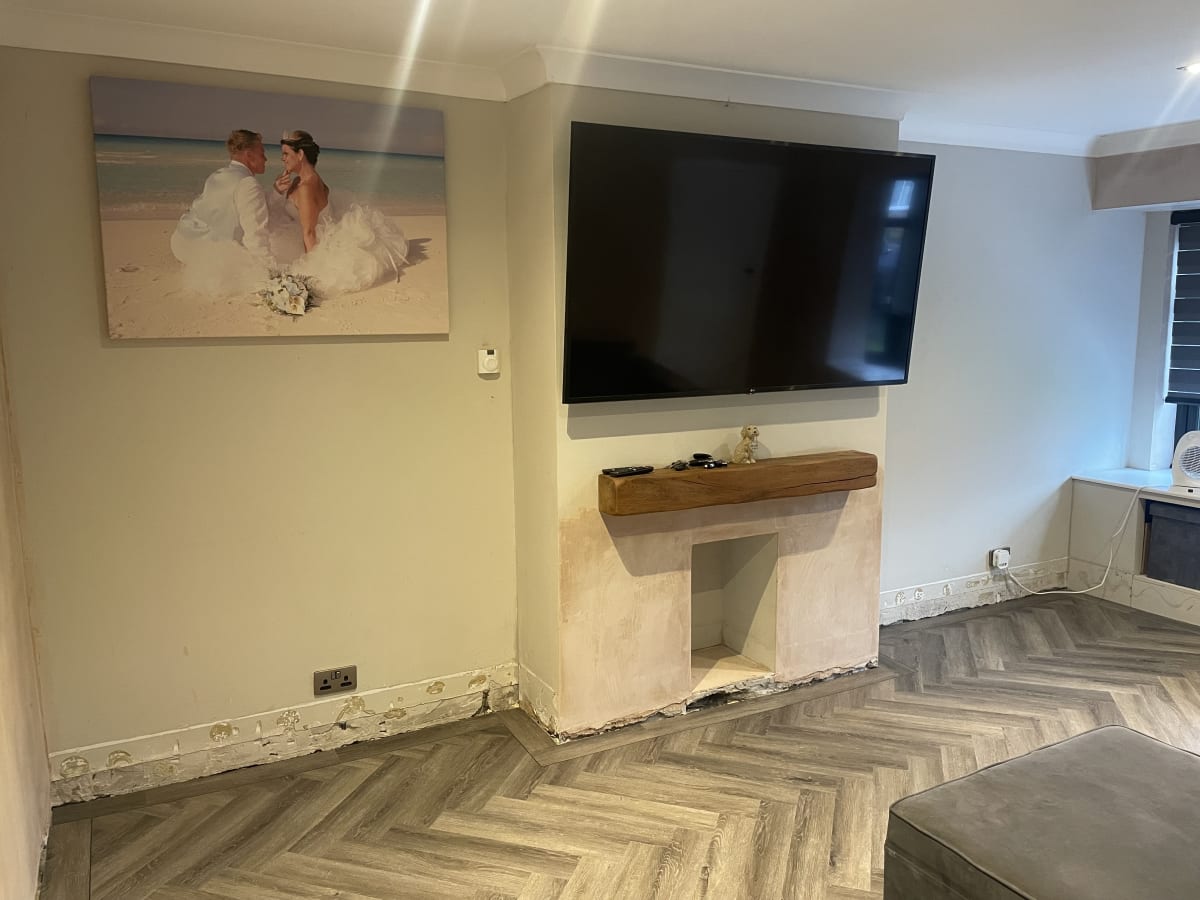
Real customer TV wall panelling



Frequently asked questions
Can you put a TV on wall panelling?
Yes, but the bracket should fix through the panel and into the wall behind it, not into the panel face. Decorative panelling is a finish layer; the bracket needs to land in masonry, blockwork, a stud, or a proper plasterboard anchor. Slat and felt-backed panels will pull on the fixings over time if the bracket is fixed only to the panel.
What should I put on the wall behind a TV?
The common options are acoustic slat, standard slat, fluted panels, panel moulding, MDF backing boards and PVC effect panels. Acoustic slat gives a modern look and some softening of mid and high-frequency reflection. Slat and fluted panels give a lined effect without felt backing and are easier to wipe clean. Panel moulding suits traditional or transitional rooms. MDF backing boards work when you want a plain painted TV back panel. PVC effect panels work where you want a marble, stone, brick or tile finish without using the real material.
Should the wall behind my TV be dark or light?
Dark walls reduce the contrast between the screen bezel and the wall, so the off-screen rectangle is less prominent. They suit larger rooms with controllable lighting. Light walls work better in smaller, daylight-poor rooms where dark panelling would close the space down. Cabinet balance, soundbar colour and lighting all factor in; the wall colour is part of the layout decision, not the whole one.
Can plasterboard hold a wall-mounted TV?
Plain plasterboard alone is not strong enough for most TVs on a full-motion arm, especially common 55, 65 and 75-inch screens. Dot-and-dab plasterboard with a Corefix-type anchor is fine. Properly fixing into studs is fine. Brick and blockwork are the most straightforward. A typical bracket is rated well above the weight of the screen, so the wall and the fixings are usually the limit, not the bracket.
How do you hide TV wires with panelling?
Three approaches cover most cases. In-wall conduit gives the cleanest result, but adding new 230V outlets, fused spurs or hard-wired lighting is notifiable electrical work in England under Part P. Surface-mount raceways painted to match the wall colour are neat at viewing distance and avoid the regulatory layer. Routing thin AV cables through the gaps behind a slat panel works for low-voltage cables only, with separation from any mains.
How do you mount a TV on wood panelling?
The same way as for any panelling: the bracket fixes through the panel and into the structural wall behind. For slat-style panels, cut around the bracket footprint or fix through the panel into masonry or a stud. The panel face stays decorative.
What is the heaviest TV you can mount on a wall?
Most full-motion and fixed brackets are rated between 60kg and 100kg, comfortably above the weight of an 85-inch TV. The practical limit is the wall and the fixing system, not the bracket. A common rule from one major bracket manufacturer is that the wall should support five times the combined weight of the TV and the mount; on heavy screens with cantilever arms, that margin is what makes the install safe.
Do acoustic slat panels behind a TV help with sound?
A modest amount, mostly at mid and high-frequencies. They take some hardness off voices and treble reflections in rooms heavy on plaster, glass and timber floors. They do little below 200Hz, so bass response is largely unchanged. They are also not in the highest-impact spot acoustically; sidewalls and ceiling usually matter more for a seated listener. They will not replace proper acoustic treatment or speaker placement.